 pagespics
Mid-Year Musings
Posted on June 7, 2018
A Personal Reflection
As most of my regular readers know, I work as a teacher in India (at the wonderful Canadian International School). Teaching Internationally has provided me with opportunities to stay in countries for an extended period of time and to explore areas that would be missed as a tourist. My vocation also provides ample holiday time to explore and photograph different parts of the world. This Summer I plan to travel to the Himalayas and to Thailand. Hopefully, the Himalayas will provide plenty of local flavours for Street Photography, as well as open the doors to play with my neglected landscape skills.
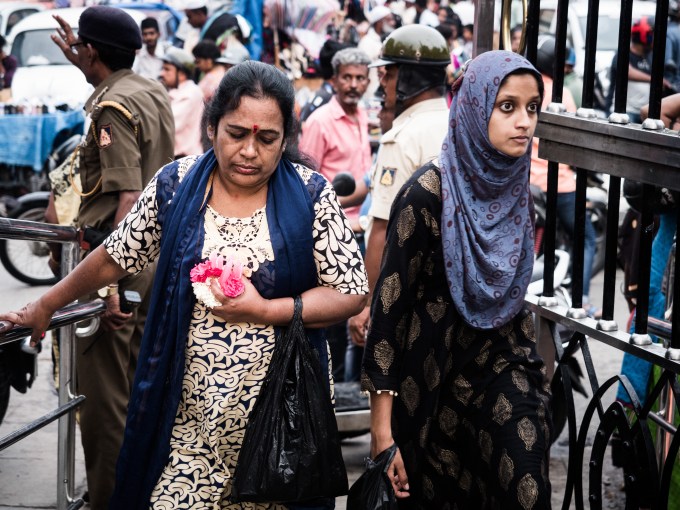
Multicultural Bangalore
Failing with a Flash
Posted on May 29, 2018
Flash Photography
I felt like a newbie. I really have not got much of a clue when it comes to using a flash. Tonight I was walking home and was told our local village was having a dance party at 7 pm. Locals dancing is something I definitely wanted to capture. I set out just after 6, taking along my flash unit. I have only recently purchased the Nissan i40, and really have not had a chance to try it out with my Olympus EM5ii.
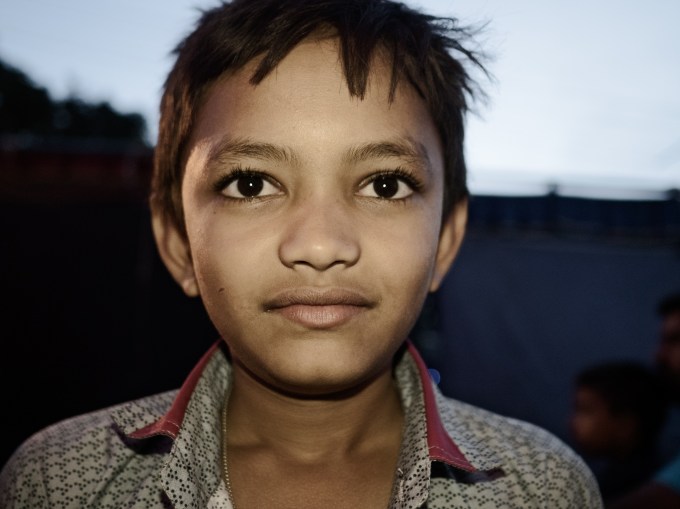
I had some success.
Walking Home and the Imperfect Photograph
Posted on May 29, 2018
The Challenge
Recently, through the StepOutPhotography Collective, my friend Birka Weidmaier has challenged me to take imperfect photos. This challenge is harsh, I know what you’re thinking, there are never any imperfect photos posted to pagespics.com! To rise to this challenge I need to look at unusual angles and focus points. Secondly, I am not allowed to crop or adjust the horizon on my photos. I can take a week deciding if a horizon is straight, and trying to get it wrong ON PURPOSE sends shivers down my spine.

At an Angle!
My Dream Camera
Posted on May 5, 2018
Firstly, sorry to anyone who clicked on this post expecting a half serious article on Street Photography. I am not about to tell you what my ‘dream camera’ is, as lets face it, they are all pretty much awesome. Instead I am going to tell you the camera that was, quite literally, in my dream. More precisely, it was the lens that I dreamed about. Weird, maybe it is time I searched for a life outside of photography (nah…).

Shot using the Nikon 35mm 1:8. A ‘dream’ lens for anyone with a cropped sensor Nikon.
Photography Gear For Hot Climates
Posted on May 1, 2018
What do you need for a Days Street Photography in a hot country?
India is HOT at the moment. Currently, Bangalore is subject to brief, but heavy tropical rains. This weekend I found myself taking photos in one of the Cemeteries close the to centre of town. On the way to town, the skies turned black. By the time I arrived at the Graveyard the heavens had opened, and it was raining cats and dogs. I ran to the nearest area of shelter, on the edge of the cemetery and sat amongst the gravediggers waiting for the rain to subdue. Sometimes adverse conditions lead to opportunities, and I came away with photos to compliment a project I am currently working on.

Asking Permission to Photograph People
Posted on April 19, 2018
When do you need to ask permission to take someone’s photo? I’m going to put legal issues aside as they differ from place to place, suffice to say that you need to be aware of what they are, particularly when traveling abroad. I have met photographers who will always try to seek permission from their subjects and others who swear they never will. However, from my perspective, there is no simple answer to when consent is required.
To make this question a little easier to answer, let’s look at the types of photos you may take that include people.
The Establishing Shot
I usually have an idea of where I am going to be tackling a photography session. One of the first photos I take is a wide-angle establishing shot. The establisher is often just a personal record of where I have been, although good lighting will often lead to a fantastic photo in its own right. As this picture is a wide angle of a street, there will invariably be people in the frame. I have rarely been worried about permission in these instances. There are too many people to ask, and people rarely appear to notice a photographers presence.
The Classic Portrait
I use a wide-angle lens for portraits, and appreciate the slightly exaggerated headshot these lenses create. This style of shooting means I am very up close and personal with the subject. In these instances, permission needs to be sought. Often, I will not talk to my subject at all, a nod at the camera suffices for a question, and a returning smile indicates they are happy having their image captured. While communication is minimal before capturing this style of photo, afterward I will share the image and try to find out a little more about the person.

Tattooed Face
Why It Does Not Have To Be In Focus
Posted on April 13, 2018
Modern Photography Explained
by Jackie Higgins.
A Book Review (and a rant)

Street Photography is not the sole focus of this book. The author addresses a range of genres and styles, identifying images as artwork and drawing readers away from a mindset of the camera being a faithful servant of all that is real. However, included in this book are some photographers who are well known for shooting Street and Documentary. These photographers include Lee Friedlander, Martin Parr, Philip-Lorca diCorcia, Henry Cartier-Bresson, Daido Moriyama, William Eggleston, Nan Goldin, Nobuyoshi Araki and Birdhead. There are more. Never heard of Birdhead? Google is your friend.
This book has sat by my bed for a week, and I think I have read it all. Although like many photo books, I failed to read it linearly, instead I darted from one photographer to the other. The pictures in this book are much more than faithful reproductions of life, the artists have added value to the images taken. Art is evident in Friedlander’s selfies, or his obsession with his own image, which is often visible as a shadow in his work. Other examples include Martin Parr’s practice of having a local artist take his portrait when traveling, or how Nan Goldin’s original (and incredibly personal) work was a slideshow set to music.
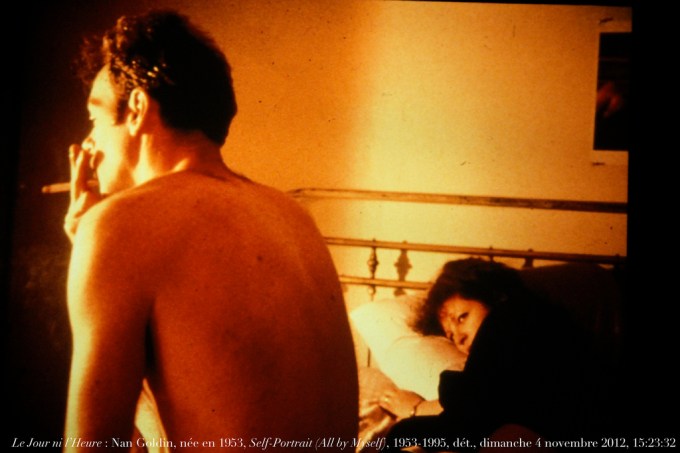
Few artists have documented life quite as personally as Nan Goldin.
I believe Street Photography is art, which makes this book important. The camera can be a witness; all be it an unreliable one, fallible to the opinions of the operator. The salience of this increases with each new camera model increasing in speed, sharpness and with more pixels than ever before. Photos do look like what they represent, and that is the problem. Street Photography can be boring. I don’t want to look at photos of people walking down the street, sitting with a coffee, or waiting for a train unless the image has been taken and processed with artistic intent; not processed in-camera to a software engineers specifications.
This book offers insights into how we can be more than a photographer and pushes us to be artists, even when focused on the mundane. Street Photography can inspire, amuse or leave us with questions. Jackie Higgins has written a book that demonstrates all the above, and it should be bedtime reading for us all. Rant over…
Now there is a long weekend ahead of me full of Street Photography. However, I will try not to be a photographer and instead try to think more like an artist. Let’s see how well I do.
Take Care and Keep Clicking
Chris

Using Auto Mode To Learn Photography.
Posted on April 4, 2018
Firstly, thanks to Anuj Agarwal for including this blog in the Top 75 Street Photography Blogs & Websites. I’m in at Number 54, which can’t be a bad thing. I now get to use this rather snazzy looking award. Check out the full list of sites at blog.feedspot.com/street_photography_blogs/
When to use Auto Mode
Yesterday I shot with the intention of seeing how my new Sony Rx100 iv behaved as a camera for Street Photography. Read any reviews on the Sony Rx series, and it soon becomes clear that the controls are not user-friendly. This camera begs for use of automation. Putting the camera in Auto mode strips the user of some artistic control, such as choice of f-stop, or the focus point. However, cameras appear to be growing in ‘intelligence’, and sometimes the auto mode will make a far better choice of settings then you or I ever would.
The Importance of EXIF
My argument for using Auto mode is that it is a tool that can teach us more about how a camera works. To learn what the camera can do, you need to study the EXIF data. For any newbies out there, this is the information stored in the file telling you the settings used. The EXIF will state the ISO, Aperture, Shutter Speed and Focal Length. When using Lightroom, hitting ‘i’ will bring up this information. Checking the EXIF will give you a good starting point for what settings you can try, and it will also tell you a little bit about your camera.
What I Learned
My learning experience will be different to yours; this information is just an example of what the EXIF can teach us. Firstly, I was pleasantly surprised at how the camera kept the ISO low. A low ISO means less noise and a better quality photo. Unless I discover a shortcut, this particular camera is likely to remain in Auto ISO mode as I am happy with the settings it defaults to (Although I may see if I can set the front ring to adjust this setting).

EXIF: 1/80 sec, f/2.8, ISO 800
Secondly, the camera ‘chose’ an F-stop that was much lower than I would have dialed in. I often shoot using a high F-stop to get everything in focus (except for Street Portraits), however, with the Rx100 images look sharp enough at around f2.8. There is a reason for using different aperture settings with respect to sensor size. I have always used an APS-C or a M4/3 sensor. The Sony has a smaller 1″ sensor. The smaller the sensor, the lower the f-stop can be while retaining sharpness, i.e., I will go up to f8 using my Nikon D7100 (APS-C sensor) and up to 5.6 with my Olympus (M4/3). After studying my EXIF, I will stick to 2.8 for most of my Street Photography undertaken with the Sony Rx100.
The EXIF showed the camera chose an adequate shutter speed, although it erred on the safe side, often shooting at 1/200+ for stationary subjects . With the camera’s five-axis stabilization, I know I can take photos handheld with speeds as low as 1/30 of a second. Shutter speed is one reason why I would never default to just using Auto mode. I can see how fast something is moving and know the shutter speed my camera needs to be set for keeping an image sharp.
Focus on the frame, not the camera settings.
To learn effectively, it is often wise to focus on ONE skill. If you are not proficient at getting out of auto (or slow at finding the right settings), then you can choose to allow the camera to handle all of that for you. AUTO mode will free you to think only about composition, a skill arguably more important than understanding a camera’s settings.

EXIF: 1/250 sec, f/2.8, ISO 125
Now get out of AUTO!
I am not advocating using the Automatic mode all the time. Ultimately it will make you a lazy photographer. Learning how the different settings work will give you artistic freedom to create the photo you envision when spotting a scene of interest. However, don’t snub it – the technology is becoming better all the time, and the camera can make some significant decisions on its own. Don’t forget to study the EXIF data to find out what the camera has done. Follow this up by thinking about WHY the camera has chosen the settings it did.
That all for today folks. Keep an eye on my Youtube channel. My next Vlog post is going to go into more depth on my experience of using the Sony Rx100 iv for Street Photography.
Take care and Keep Clicking, Chris

London, a New Camera and a Couple of Books.
Posted on March 29, 2018
London
Bit of a laid-back and lazy blog post today – just ‘cos that is the way I am feeling. First up London. I did not get a chance to do any Street Photography in London as it was a whirlwind stop over and there were far too many other things to do. However, I was staying just behind the Tate Modern and managed to take the photo below from the viewing tower. Although this looks like an architectural photo, I took a while to find some people that would stand out in the gap between the two buildings. I believe that the inclusion of the two people, who are defined, place this photo into the classification of Street. The inclusion of the two people also add a story to the shot, where are they going, and why are there so few people in such a large area? As always, I would love to here your views – ‘what is street photography?’ is a hotly debated topic!

View from the Tate Modern
Larry Fink, on Composition and Improvisation
The Tate Modern has a beautiful collection of books on Photography. I purchased ‘Larry Fink, on Composition and Improvisation. Larry’s photos consistently fill the frame with action and a story. This book does not contain stark minimalism and negative space! I chose this book as I often feel that my photos are too minimalist – often to the point where I am cloning out distractions in search of the ‘perfect frame.’ Of course, the perfect frame does not exist, but looking through this book, I can see numerous ways that my work can continue to grow. The second book I purchased is ‘Why It Does Not Have To Be In Focus – Modern Photography Explained,’ by Jackie Higgins. Again, my choice of book is pulling me away from ‘perfect frames’ and towards greater experimentation – an example of which is below!

Taken at the Tate Modern Viewing Tower. My Son appears in the frame on the right – at least he has a camera in hand!
The Sony Rx100 iv
Since my Ricoh Gr died, I have been looking for a small compact camera. I have gone with the Sony Rx100 iv. It is tiny and goes into my pocket, while still having a reasonably sized sensor. With this camera I lose a lot of creativity – so it will never replace my Olympus. The camera will likely remain in Aperture Priority mode, and I will leave the computer to set the white balance and ISO. With a couple of clicks, the camera also appears to know what I want to be in focus, although I have no idea of the magic that is at work here. Tomorrow I will try this camera out for Street Photography, as I am in a small Market Town, which should be busy on Easter Monday (starting with a canoe race on the canal). As ever, I will let you know how I get on.
One last ‘plug’ – I purchased my second camera bag made by ‘Crumpler’, these are excellent camera bags and I strongly recommend their gear.
Take Care and Keep Clicking,
Chris
Traveling with the Olympus EM5ii.
Posted on March 21, 2018
During the last couple of weeks, I have not been posting much online. I have been visiting a remote location with no wifi and a phone that ran out of credit. However, I have still been busy on a couple of projects. The photos will emerge at some point, so watch this space. Here is a little teaser of what I have been doing.

Karate Kid was happy to perform for the camera.
The Nilgiris Hills, India
I am fortunate to have spent the last week camping out with my Grade 6 class at the Nilgiris Hills, in Southern India. As well as being responsible for student wellbeing, I also had the task of photographing the week’s events. My gear of choice was the Olympus Em5ii with the 12-40mm and 25mm lenses. I am used to using this camera for a day’s photography. However, using it for a full week, from when I woke up to when I went to bed was going to show up its strengths and weaknesses.
Battery Life
I took two batteries with me; one is an official Olympus battery and one a cheap knock-off from China. In general, there was always a charging point nearby. However, the life of these batteries is still way shorter than with my Nikon D7100, which can run for days without a charge. A couple of tips, turn the screen around and just use the EVF. I also turned off the image stabilization for a lot of the time; mainly when there was a lot of sunlight. Mirrorless has caught up with DSLR’s in every aspect but battery life, and the Olympus range of cameras is no exception.
Lens Choice
The 12-40mm lens will remain my go-to choice for Street and People Photography. However, in this situation, there were times when I wished my lens had more reach. While nature photography is not my usual bag, if I see a wild animal then I damn well want to capture of shot of it. As well as a plethora of exciting bird life, I was privileged to witness a herd of wild Gaur, these are huge horned cows and are pretty dangerous. I managed to get reasonably close for a picture but would have loved a longer lens. The 12-40mm range also falls short when needed for sporting activities, such as abseiling. On the Street, I can get close to people, but with nature and sport, this intimacy is not so achievable. Olympus have a 12-100mm lens that would be ideal for this kind of camp, but I don’t think I would want to be using a lens that big and heavy every day. The strength of the 4/3’s system is, in part, due to its compactness.
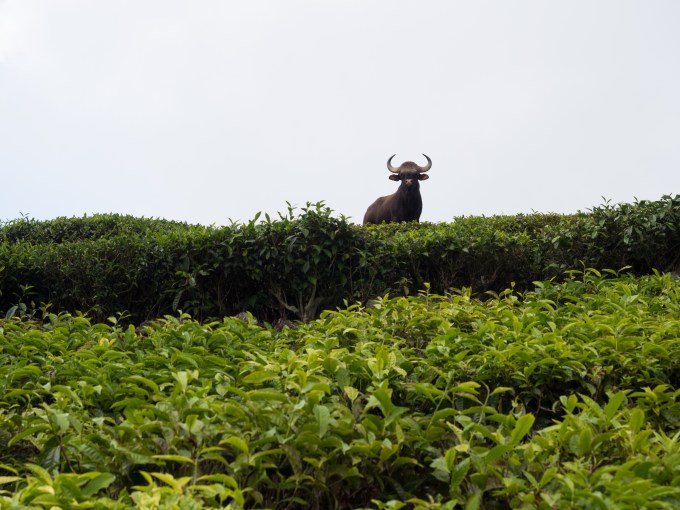
A Wild Gaur. One of the few times I wish I had more reach with my zoom.
Firmware and User Experience
I had updated the firmware and lost my customized settings, and this meant I had to set my camera up once more. Re customizing my camera turned out to be a good thing, and I am now pretty happy with my settings, which I will share with you at some point. People criticise the controls of the Olympus cameras, but time spent customizing your Olympus camera will make it sing. While away I also had a chance to play with the pixel shift technology, for some reason the camera chose to shoot in Jpeg format, which while not ideal, helped to ensure that I got it right ‘in camera.’ However, this is not a feature I am likely to use much.

Landscape taken using the Olympus ‘pixel shift’ technology. Edited with a filter using On1.
Photos and Video Quality
Once again, I love the images captured with this camera. For a short period, I will leave the album up on this site (https://pagespics.com/nilgiris-camp/). The photos are a little different from my usual fare, but it is a great way to share the images with the students who came on camp. Again, I always shoot RAW to get the best out of my camera. To edit the multiple photos quickly, I used the synchronize option in Lightroom.
I do not usually use my Olympus for a lot of video. However, this may change as I am happy with the footage captured. The 5 axis image stabilisation worked a treat. You can see the final edited version of the movie on my YouTube channel. The image stabilization meant I could leave my tripod in the bag. Again, with Micro 4/3’s less is more! I love to travel light. My editing was carried out using iMovie, although basic, it is a piece of software that gets the job done, plus the price is perfect!
Final Thoughts
I had a great week, taking pics with my camera. I loved its compactness and versatility, and the photos look great. I would have liked the batteries to have had a better life and would have appreciated a little more length on the zoom. If I threw money at these issues, I could get a battery grip and the 12-100mm lens. However, there is no extra pay for taking photos when I am at work, so it would be hard to justify the cost. Adding these extra’s would also negate the advantage of the system’s compactness, plus I do not need either of these items for my Street Photography.
The Week Ahead.
Tonight I head for a brief stint in the UK, which is covered in snow. It has been a few years (at least) since I last experienced cold weather and I own NO warm clothes. Hopefully I will get a chance get out and capture a little Street Photography.
 pagespics